Cyclone Jolina Provides a Clear Example of Medicane Formation and Highlights Socio-Economic Risks in the Mediterranean
Medicanes, tropical-like cyclones occurring in the Mediterranean basin, are relatively infrequent but can rank among the most impactful extreme weather events in the region, particularly due to their potential to generate significant socio-economic damage in densely populated coastal areas.
Within the framework of the MEDICANES project, funded by the European Space Agency (ESA), researchers are advancing the understanding of these complex systems through the integration of satellite-based Earth Observation, high-resolution numerical modeling, and interdisciplinary scientific approaches. The project aims to improve the detection, characterization, and prediction of Medicanes, while enhancing the anticipation of their impacts across vulnerable Mediterranean regions.
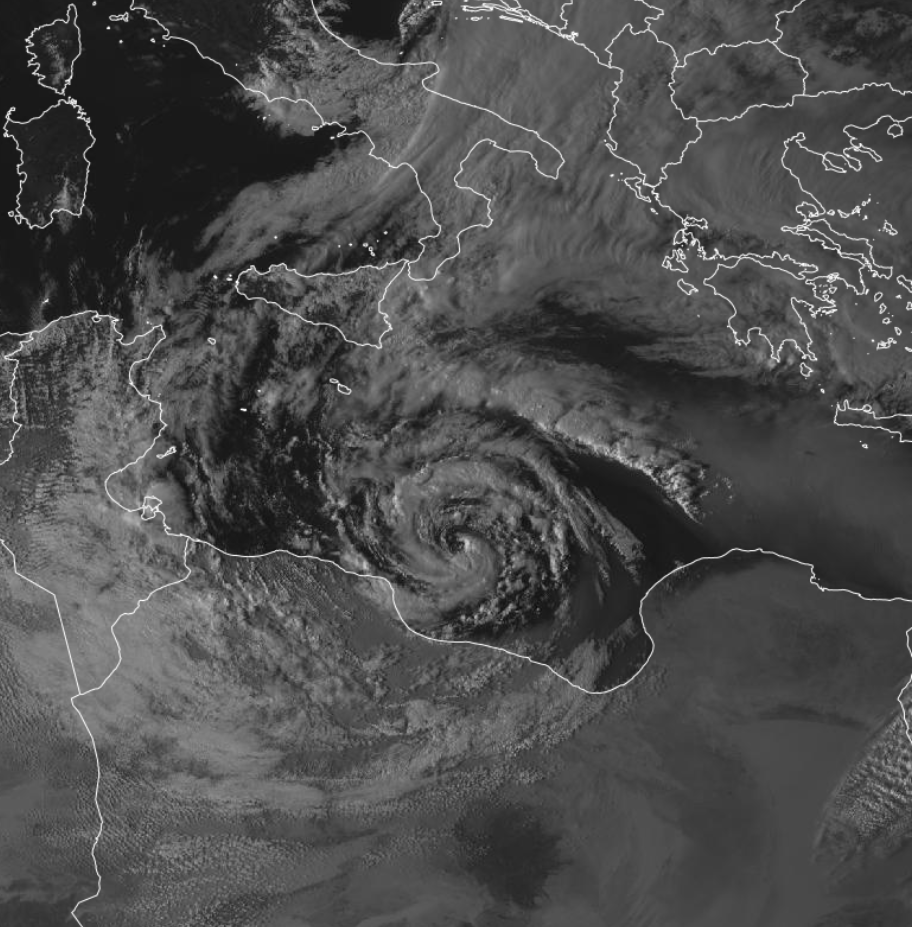
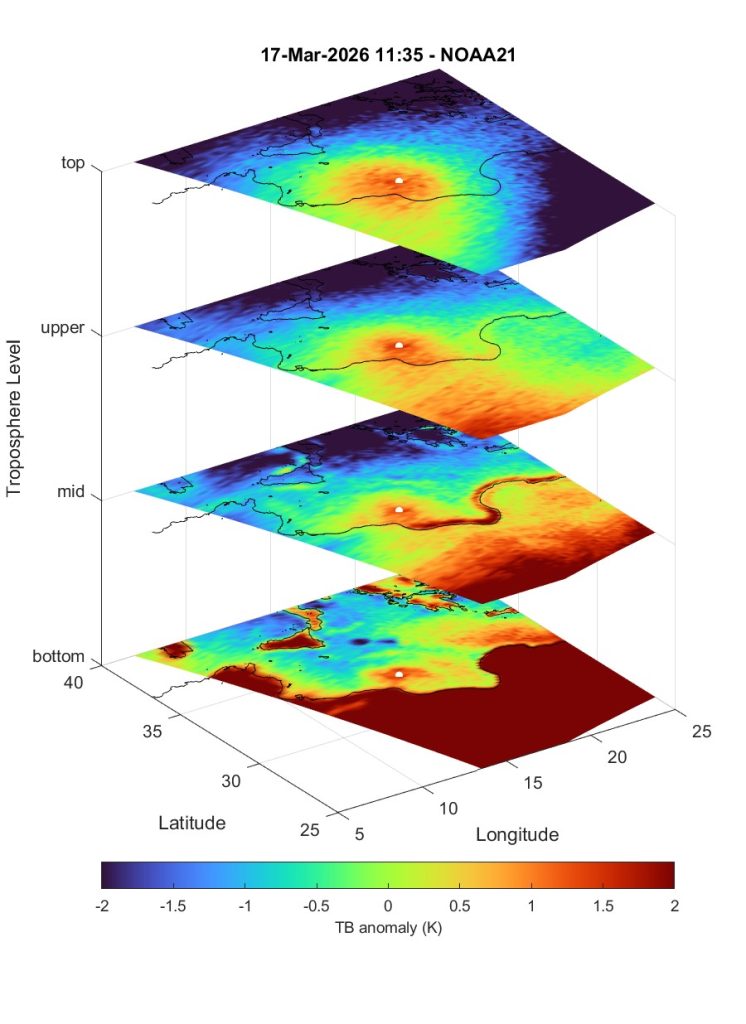
Recent satellite observations have tracked the evolution of Cyclone Jolina, which originated as a mid-latitude baroclinic disturbance and progressively transitioned as it moved across the Mediterranean toward the Libyan coast. During the final stage of its lifecycle, the system evolved into a structure exhibiting the defining characteristics of a Medicane. According to the current observational definition, a Medicane is a mesoscale cyclone over the Mediterranean featuring a vertically extended warm core, spiral cloud bands, and an eye-like structure embedded within a nearly symmetric wind field.
As Jolina approached Libya, microwave and infrared satellite data revealed a clear tropical-like transition—from a cold-core, asymmetric disturbance to a compact, diabatically driven warm-core system. This transition occurred under relatively cold sea surface temperature conditions and during an atypical period of the year, further underlining the scientific relevance of the event.
Beyond its meteorological significance, Jolina has already demonstrated the socio-economic risks associated with Medicanes across the central Mediterranean. During its early stages, severe weather conditions triggered multiple warnings from emergency services in Italy and Libya. In Italy, several municipalities in Sicily and Calabria closed educational centres, while strong winds and heavy rainfall caused damage to buildings in provinces such as Catanzaro and Cosenza, and led to flight cancellations in Catania.
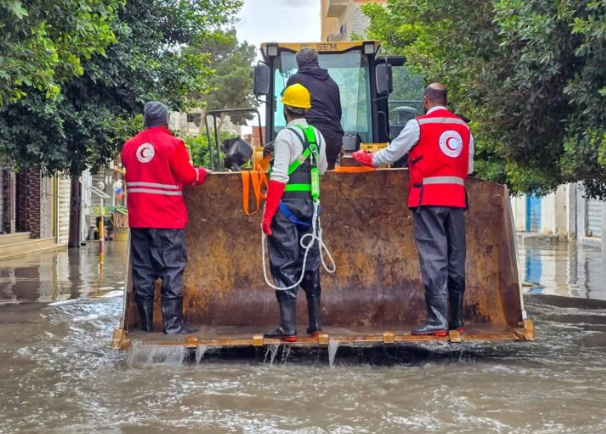
The most severe impacts were observed in Libya, where extreme precipitation caused flooding in urban areas including Tajoura and Zawiya. In Tajoura, a young man tragically lost his life during volunteering activities, highlighting the human cost associated with such events. These impacts illustrate how Medicanes can affect critical infrastructure, disrupt transport and maritime operations, and generate cascading economic effects, while placing additional pressure on emergency response systems. In highly exposed coastal regions, even moderate-intensity systems can result in substantial socio-economic losses.
This case exemplifies the increasing capability of Earth Observation systems to monitor the full lifecycle of such events in near real time. Rather than relying on retrospective classification, scientists can now observe and analyze the physical processes that define Medicane formation as they occur. Although Jolina may not be the most intense system of the season, it represents one of the clearest real-time examples of Medicane development under a robust observational framework, contributing valuable insights for both scientific research and risk management.